
Earth, Our Home
Sunday, July 19 at 4:00PM
Earth, Our Home
Sunday, July 19, 2026
4:00PM - 6:00PM
Melville United Church
300 St Andrew St W, Fergus
$58 Adult | $20 Student | $10 Child
Mark Vuorinen, conductor
The Elora Singers
Noël Wan, harp
The Elora Singers welcome harpist Noël Wan for an evocative program where shimmering harp and luminous voices intertwine. Music by Johannes Brahms, Lili Boulanger, and Samuel Barber reveal the rich colours and delicate textures that emerge when harp and choir come together. From moments of intimate stillness to sweeping waves of sound, this concert invites listeners into a beautifully immersive musical landscape. The Elora Singers will also give the Canadian premiere of Nicholas Cline’s The Sea Came Up and Drowned, a piece co-commissioned by The Elora Singers.
**VENUE CHANGE** Please note that the venue for this concert has changed to Melville United Church in Fergus.
Concert Program
Hymne au soleil - Lili Boulanger
The Evening Primrose - Benjamin Britten
To be Sung on the Water - Samuel Barber
Sure on this shining night - Samuel Barber
Prelude in C Major, Op. 12, No. 7 - Sergei Prokofiev
“Choral Dances” from Gloriana - Benjamin Britten
The Sea Came Up & Drowned - Nicholas Cline ***
4 Gesänge, Op. 17 - Johannes Brahms
Soleils de Septembre - Lili Boulanger
The Searching Sings - Murray Schafer
*** Canadian Premiere

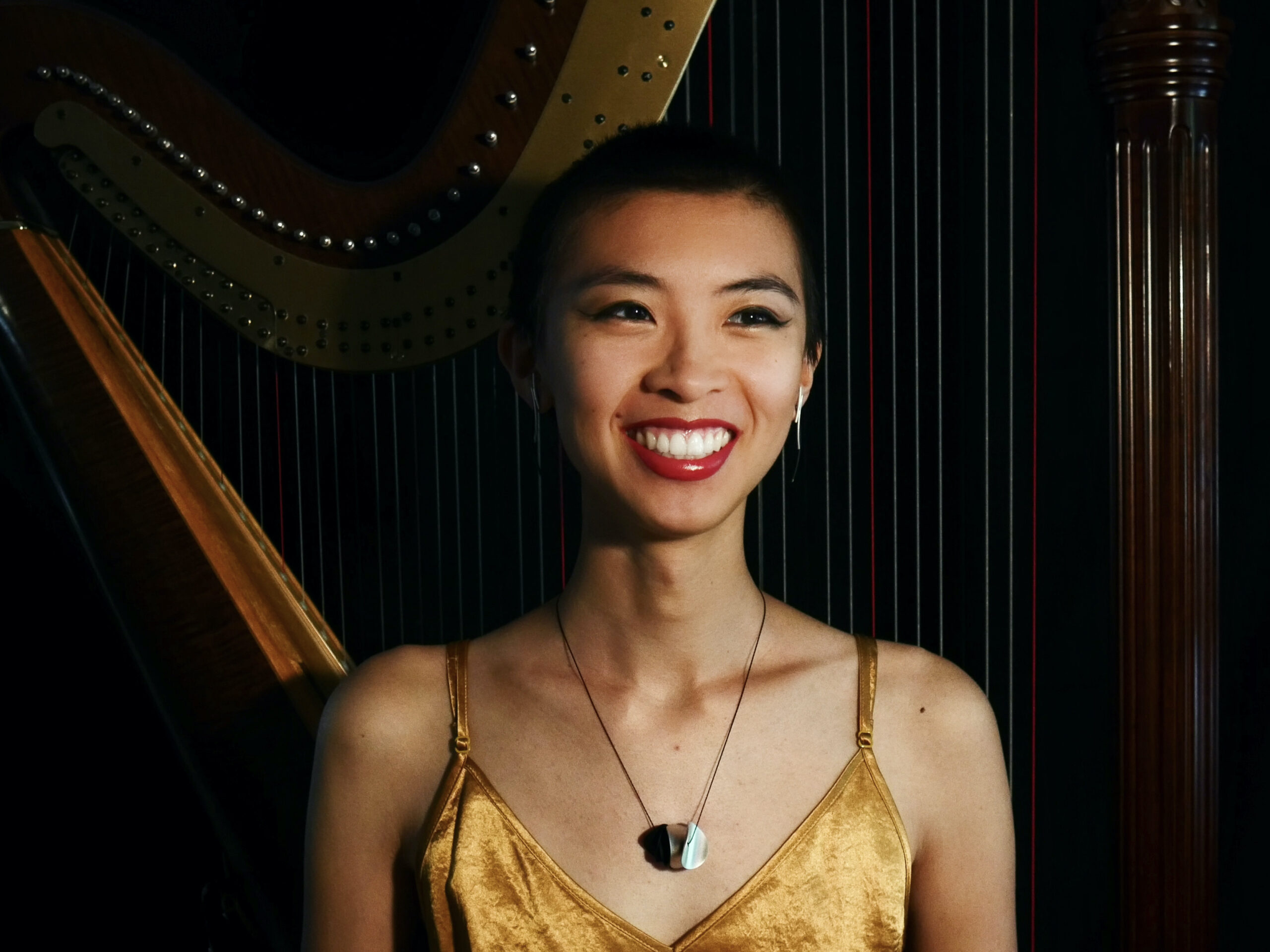
Noël Wan
Lauded as “a huge talent with hidden power and amazing maturity” (Bart van Oort) and “not [a harpist] to be slept on” (The Globe and Mail), Taiwanese-Canadian-American Noël Wan 萬依慈 commands a remarkably fresh creative voice, bridging charismatic artistry and intellect in her work as an international prize-winning solo harpist and interdisciplinary scholar.

Nicholas Cline
Nicholas Cline makes music for voices, acoustic instruments, and by electroacoustic means. Deeply influenced by the natural world, his music draws on a broad range of subjects and experiences with the belief that music reveals, challenges, and shapes the listener’s understanding of the world.
The Sea Came Up & Drowned
This work was commissioned for The Crossing, Donald Nally, conductor; Stare at the Sun, A.J. Keller, conductor; Roots in the Sky, Andrew Major, conductor; Pittsburgh Camerata, Mark Anderson, conductor; The Elora Singers, Mark Vuorinen, conductor; Madison Choral Project, Albert Pinsonneault, conductor; and Volti, Robert Geary, conductor.
The sea came up and drowned. A sentence with a missing object. An ending that has been lost. Or not yet come to pass. A foretelling. The same story, repeated.
The erasure poems in Rachel Jamison Webster’s book, The Sea Came Up & Drowned, were “mined,” each from a single page of John McPhee’s Annals of the Former World, a monumental work that chronicles the geologic history of North America from New Jersey to San Francisco. Like the earth it describes, Annals of the Former World tells a story of many layers, offering the reader one of many paths through it – a geology primer, an exploration of plate tectonics, a study of geologic time.
Likewise, Webster’s The Sea Came Up & Drowned offers the reader multiple paths through its poems. The words tumble across the page, asking the reader to fill in the gaps between fragmented deposits. From the histories of westward expansion, patterns emerge in the distillation of McPhee’s words – colonial exploitation, extractive economies, and the costs of human erasure and climate upheaval.
As a meditation on deep time, The Sea Came Up & Drowned points toward other ways of knowing. The final section offers both hope and caution as we approach possible conclusions to the question posed by the title. In our progress and missteps, “Remember, our confusion will reach new heights of sophistication. We lurch forward from error to discovery to error to discovery. The fossil record will tell what happened. If not, it didn’t happen.”
Poetry from The Sea Came Up & Drowned by Rachel Jamison Webster.
Permission granted by Rachel Jamison Webster.
Published by Raw Books Press, 2020.
Poems mined from Annals of the Former World by John McPhee.
Permission granted to Rachel Webster by John McPhee.
Published by Farrar, Straus and Giroux, 1998.